Elysium is bringing its Hyperliquid node to TheHUB in Tokyo
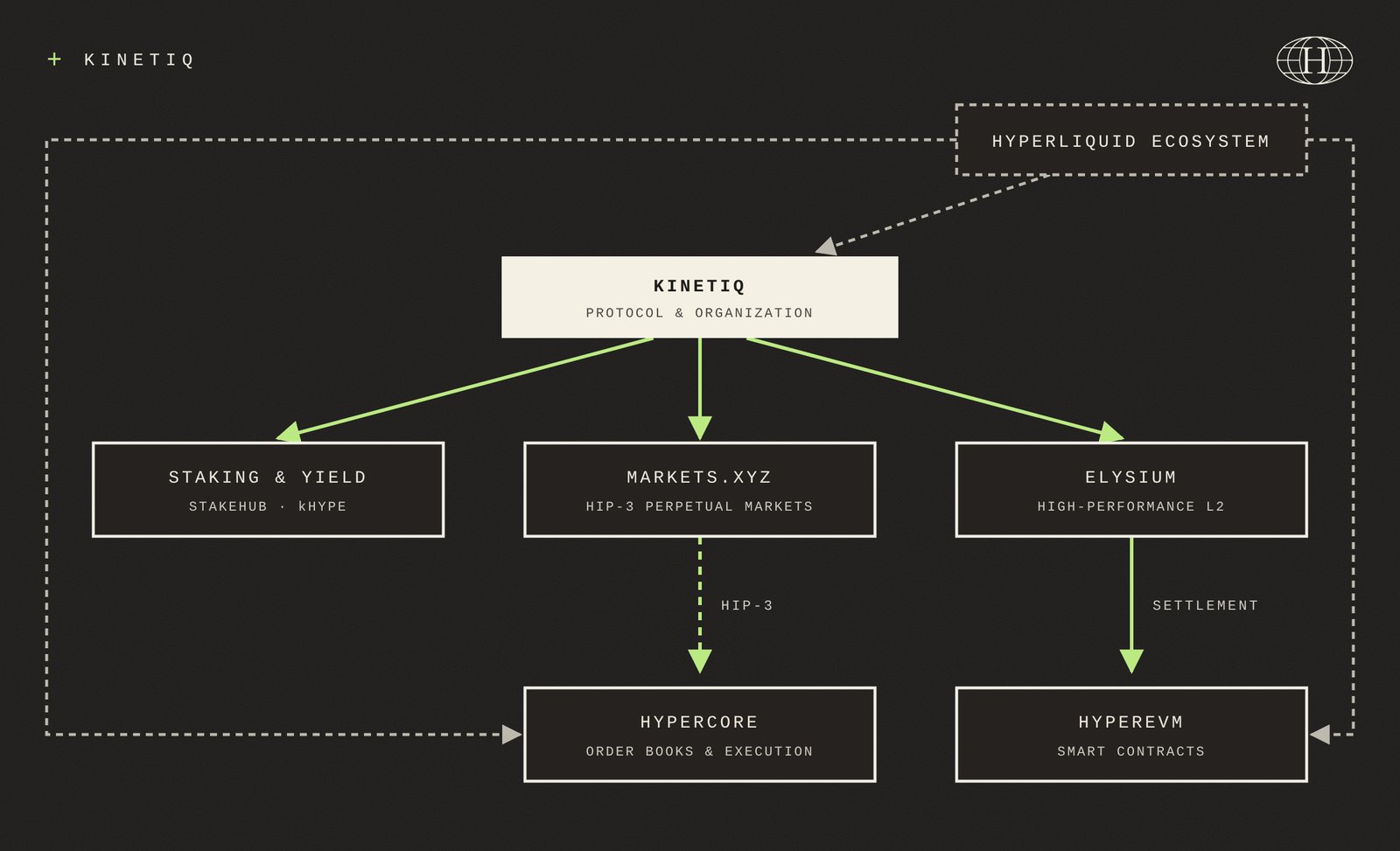
Elysium, the Layer 2 blockchain that Kinetiq is building for the Hyperliquid ecosystem, is deploying its Hyperliquid node to TheHUB, the purpose-built colocation facility for digital markets inside the Equinix data center in Tokyo. The node carries Hyperliquid’s state into the chain, and it will also let smart contracts on Elysium read HyperCore data, such as order books, prices and positions. That feature is planned for a network upgrade about four weeks after mainnet launch.
Kinetiq Ecosystem and Hyperliquid
Kinetiq started as a liquid staking protocol built on Hyperliquid, allowing users to stake HYPE while retaining liquidity through kHYPE. Over time, Kinetiq expanded beyond liquid staking into institutional staking, yield products, and trading infrastructure, including infrastructure for HIP-3, Hyperliquid’s framework for builder-deployed perpetual markets. Kinetiq’s HIP-3 venue, Markets.xyz, offers perpetual futures on traditional assets, including equities and commodities.
The latest addition to this growing ecosystem is Elysium, a high-performance Layer 2 designed for trading-intensive applications. It builds on Hyperliquid’s existing architecture, which combines HyperCore, responsible for order books and trade execution, with HyperEVM, its smart-contract environment.
An L2 for high-frequency trading and prop AMMs
Elysium is designed to support applications that require greater throughput and shorter block times than HyperEVM was designed to provide, without taking developers outside the Hyperliquid ecosystem.
Its primary use cases include high-frequency trading applications and prop AMMs. Unlike conventional AMMs that use fixed pricing formulas, prop AMMs allow professional market makers to actively update prices in response to market conditions.
Where TheHUB fits in
Elysium’s Hyperliquid node will run on dedicated bare-metal servers at TheHUB, supplying the HyperCore data that smart contracts on Elysium will use.
TheHUB provides a shared physical environment where exchanges, trading firms, bare-metal providers and node operators can deploy their infrastructure, connected through one network.
Trading venues that run their matching engines inside TheHUB connect to colocated firms through latency-equalized network paths designed to be the same fiber length to the matching engine; trading venues compete on market design, while traders compete on strategy and execution.
“Tokyo is a center of gravity for crypto activity. It’s no coincidence that we chose it as TheHUB’s first location, and we’re glad Kinetiq is bringing Elysium’s Hyperliquid infrastructure here.”
— Thiago Rüdiger, CSO of Global Kiwi Labs
“Prop AMMs and high-frequency strategies are only as good as the data they price against. Running our Hyperliquid node at TheHUB puts Elysium’s view of HyperCore right beside the market itself, so contracts on Elysium read order books, prices and positions at the freshness professional market makers expect. Builders get speed and deep HyperCore liquidity without leaving the Hyperliquid ecosystem.”
— Justin Greenberg, CTO of Kinetiq and Elysium
What’s next
Elysium’s mainnet is scheduled for November 9. Builders are already working on its testnet; developer guides are available at elysium.kinetiq.xyz.
Many of the applications Elysium is built for, from high-frequency trading to prop AMMs, depend on trading systems that their teams run off-chain. Those teams can host their systems at TheHUB, on their own servers or on rented bare metal.
To get in touch, write to info@global-kiwi.xyz.